Popular Posts

Labels

Showing posts with label Wild Berries. Show all posts

Sunday, 21 May 2017

Wild Blueberry Biscuits:


2 Cs Flour
1 C milk (cold)

1/3 Cup sugar
5 Tbsps. of butter (cold or frozen)
4 tsps. baking powder
1 tsp salt
3 ozs. wild blueberries (fresh or frozen)

At home, Glaze:
1 C powdered sugar
1/8 C water
1 tsp. vanilla
½ tsp. lemon juice
Directions:
Preheat oven to 450F. Mix salt, sugar, flour, and baking powder in a bowl. Add the super cold milk into dry ingredients and mix. As dough begins to form take each tablespoon of hardened solidified butter and break chunks off and spread evenly over dough. Fold dough, and knead… repeat until all butter is spread in chunks evenly throughout dough. Move dough to floured cutting board and roll flat to about ¼ - ½ thick (or to desired thickness) and cut approximately 6 biscuits with a biscuit or cookie cutter. If you notice the butter start to melt (hot kitchen) during this process it may be necessary to return the dough to the freezer for 10-15 minutes. Do not exceed 20, as the baking powder’s 1st stage may become inactive past that. Place in oven and bake for about 7-12 minutes. Melt 1 tablespoon of low-fat butter in the microwave, and paint finished biscuits with pastry brush. Mix glaze ingredients in a bowl, and drizzle over biscuits. © Al (Alex-Alexander) D Girvan.

Friday, 12 May 2017

SAFE, Tick Removal


Even better than tick removal is to AVOID allowing ticks to attach in the first place. Wearing long pants and sleeves, and walking with a friend who can keep an eye on your back means that you have time to see the tick and brush it off before it attaches. Keep switching positions of who is in back if walking single file. Look frequently for signs of ticks on you or your friend. If you find an attached tick, remove the tick as completely and as quickly as possible.
How to Properly Remove a Tick
Do you remember being told to burn a tick or cover it with nail polish, lighter fluid or petroleum jelly to remove it?
Well, the old methods often cause the tick to vomit the contents of its gut into the bite.  According to research, all of the improper tick removal can increase your chance of contracting Lyme disease.
• Researchers have discovered that the spirochete that causes Lyme disease is actually found in a tick’s gut, not its mouth.
• Removing the tick’s mouth isn’t really as important as we were all taught years ago.
It’s much more important to make sure the tick doesn’t “throw-up” the contents of its gut when removing it.
• As a tick feeds, it regurgitates germs from its gut into the bite site, and each “burp” increases the likelihood of Lyme disease transmission.
• It’s still important to remove ticks promptly, though, because many ticks have Lyme spirochetes in their saliva along with the bacteria for other tick-borne diseases and the more bacteria injected when a tick bites, the higher the chance you will be infected.
• Nymphs (young ticks) actually cause most cases of Lyme disease. It’s difficult to
remove a nymph without squeezing the nymph’s abdomen with tweezers, so the tick
removal tool is recommended
• If ticks are found and removed right away, they may not have time to give you Lyme disease.     It often takes several hours for a tick to give you the germs. If no tools are available, rather than delay use a cotton thread. Tie a single loop of cotton around the tick’s mouth parts, as close to the skin as possible, then pull upwards and outwards without twisting.

DO start by cleansing the tweezers/tool with antiseptic. After tick removal, cleanse the bite site and the tool with antiseptic.

DO wash hands thoroughly afterwards.

DO save the tick in a container in case a doctor asks for evidence that you have been bitten (label it with date and location). Public Health England is also currently running a scheme to investigate ticks – see below.

DO NOT squeeze the body of the tick, as this may cause the head and body to separate, leaving the head embedded in your skin.

DO NOT use your fingernails to remove a tick. Infection can enter via any breaks in your skin, e.g. close to the fingernail.

DO NOT crush the tick’s body, as this may cause it to regurgitate its infected stomach contents into the bite wound.
DO NOT try to burn the tick off, apply petroleum jelly, PEPPERMINT OIL, nail polish or any other chemical. Any of these methods can cause discomfort to the tick, resulting in regurgitation, or saliva release.
DO NOT squeeze the body of the tick, as this may cause the head and body to separate, leaving the head embedded in your skin.
DO NOT use your fingernails to remove a tick. Infection can enter via any breaks in your skin, e.g. close to the fingernail.
DO NOT crush the tick’s body, as this may cause it to regurgitate its infected stomach contents into the bite wound. See this graphic animation of what can happen, courtesy of the Lyme Borreliosis Foundation, Hungary.
DO NOT try to burn the tick off, apply petroleum jelly, PEPPERMINT OIL, nail polish or any other chemical. Any of these methods can cause discomfort to the tick, resulting in regurgitation, or saliva release.
DO USE:
Fine-pointed tweezers.  This works for adult ticks, if you grasp the tick at the mouth, where the tick is attached to your skin; it’s not safe for the tiny young ticks, because the gut might get squeezed and squirt germs into you.
A credit card or something else you can slide under the tick.  Slide something under the tick and press upward at the mouth until the tick pulls itself out.
A tick remover that slides under the tick sells a tool that slides under the tick sells for less than $5.
After removing a tick, disinfect the bite site, removal tool, and your hands.
Tick Remover


How to Use Tick Remover
Slide something under the tick, like a tick removal tool or credit card (which doesn’t always work).
The tips of the tick remover should be pointed and a slight upward angle, forcing the tick’s head into the narrowest part of the “V.”
Grasp the tick as close to the mouth as possible (where its attached) and pull straight out SLOWLY.
Do NOT turn or twist as you pull
Disinfect the bite site and tool and wash your hands with antibacterial soap.
Mouth parts left in the skin can be removed with a sterile needle or by a doctor.  Like a splinter, they will work themselves out over a few days or weeks, but may cause itching.

Monday, 24 February 2014

Fairybells, Including the Saskatchewan Rough-fruited Fairybell (Prosartes trachycarpa


Prosartes is a genus of flowering plants in the lily family. For several decades plants of this genus were included in genus Disporum. Later studies of morphology and cytology, as well as genetic analysis, show the North American plants to be different from the Asian genus (Disporum)
.
File:SK-Fairybells.JPG
File:Fairybells.JPG
Rough-fruited Fairybells, Prosartes trachycarpa, Saskatchewan Rough-fruited Fairybells or  Rough-Fruited Mandarin, shown directly above, is a member of the genus Prosartes of perennial flowering plants in the family Liliaceae. The flowers are delicate and hang down. It has stamens that hang down well below the petals of the flowers, and conspicuously rough-skinned velvety surfaced orange to red berries with 6-12 seeds. The berry is larger than a Saskatoon, Pincherry or Chokecherry, about the size of a grocery store, red cherry or small grape. The rough-fruited fairybell can also be found in the same locales as other native fruits such as Saskatoons, Pincherries and Chokecherries. This perennial is 12 inches to 24 inches in height. The leaves alternate and are about 1 inch to 3 inches in length.The berries begin a yellow colour, then change to orange and when fully ripe, to red. The surface of the fruit feels fuzzy and velvety.
Prosartes trachycarpa is found in much of Western Canada. They are listed amongst plants found in the Prince Albert National Park and Riding Mountain National Park and are considered a common range plant of northern Saskatchewan.

Hookers Fairybells, Prosartes hookerhas smooth berries with 4-6 seeds

Apparently, the berries of these plants were not widely eaten by North American Native peoples; and many of the once existing British Columbia tribes considered them to be poisonous. However it has been recorded that the Thompson and Shuswap peoples ate the berries raw; and that the rough- fruited fairbells were called (in their purely oral language) what would now be translated as false raspberries. Translation of another previous, and commonly used, name; would be dog feet.
© Al (Alex, Alexander) D Girvan. All rights reserved.

Sunday, 23 February 2014

Lilies of the Valley, Convallaria majal, FALSE Lilies or the Valley, Maianthemum-False, and False Solomon's Seals

Convallaria majal is commonly known as the Lily of the Valley, is a sweetly scented (and highly poisonous) woodland flowering plant that is native throughout the cool temperate Northern Hemisphere in Asia, Europe and in the southern Appalachian Mountains in the United States of the Americas. There is, however, some debate as to the native status of the North American variety. It is possibly the only species in the genus Convallaria (or one of two or three, if C. keiskei and C. transcaucasica are recognised as separate species).
Caution is advised when eating False Lily of the Valley (as is true of most berries) eating too many can cause severe diarrhoea.
The berries of the FALSE Lily of the valley species that I mention here are considered edible but are bitter tasting and not very palatable; but remember, SURVIVAL is not about likes or dislikes. The genus name is derived from the Latin word for May, referring to the flowering time of these plants. The fruit of Maianthemum species is a true berry.
Fruit: Berries are pea- sized, hard ad green at first, then red when ripe.
Season: Flowers May to June. Fruit ripens July through September.
Description: Herbaceous creeping perennial, arising from rhizomes and usually forming large colonies. Leaves heart shaped, alternating with prominent parallel veins. Flowers small, white, with 4 petals borne in distinct clusters, blooming early spring. Fruit borne at the top of stems in clusters Found in moist clearings
.File:Maianthemum canadense-Rum River Nature Area.jpg
 NOTE: the stem less leaves of this Maianthemum canadense plant.

Wild FALSE Lilly of the Valley, Maianthemum canadense, is a smaller plant with stalk less leaves The berries are, at first, cream coloured  with red speckles, then pink, with red flecks, finally ripening to soled red. This plant is found in MOIST Eastern British Columbia forests. Also called: Canada Mayflower.File:Maianthemum dilatatum 11112.JPG
 NOTE:the stemmed leaves of this Maianthemum dilatatum plant.
File:Snakeberries.JPG

False Lily of the Valley, Maianthemum dilatatum, is the larger plant, with normally, two leaves near the top and one near the base (the leaves are stalked). Unripe berries are hard and green, turning mottled brown, then soft and red, when ripe.This plant, occurs in swampy areas and shady, moist wilds in coastal British Columbia, with a limited range in the East-Central part of the province. Also called: Two-leafed Solomon’s Seal or Snake Berries.
Many groups in British Columbia CANADA ate false Lily of the Valley, but it was rarely highly regarded as a staple food. The berries were usually only eaten by children, or by hunters, and berry pickers ont in search of other berries. However, it is claimed that the former Haida peoples once used the berries to a great extent. Apparently, they ate the berries fresh and also picked them when unripe and stored them until they were red and soft  
False Solomon's Seal, Maianthemum racemosum, grows in clumps from a fleshy root stock. The berries are first green with copper coloured spots. Also called: Feathery False Lily of the Valley.
Star Flowered, False Solomon's Seal, differentiated from Maianthemum by being smaller, with fewer flowers and leaves, and a LOT fewer,  but larger, berries. Also called Starry False Lily of the Valley
Lily of the Valley Phenomenon: The odour of lily of the valley, specifically the ligand bourgeonal, attracts mammal sperm in a dramatic manner. The 2003 discovery of this phenomenon prompted a new wave of research into odour reception, but no evidence was found that the female sex organ has similar odours of any kind.

A 2012 study demonstrated instead that at high concentrations, bourgeonal imitated the role of progesterone in stimulating sperm to swim (chemotaxis), a process unrelated to odour reception.


© Al (Alex, Alexander) D. Girvan. All rights reserved.

Friday, 21 February 2014

One-flowered Clintonia, Clintonia unifloria. Also called Queens Cup, Blue Bead, Bead Lily

The berry of this species, though unusual in appearance, is dry, insipid, and mildly toxic so is not a recommended food source. It is claimed that the former Nuxalk peoples of Bella Coola  called it "Wolf's Berry" because they considered it inedible to humans and edible only to wolves. In reality, they are eaten by many small animals and many birds, especially grouse relish the berries. It is also claimed that the Thompson peoples of the interior, once, made dye from the fruit

Twisted Stalks, Streptopus

These perennials are commonly call "twisted stalks" because of the kinks; sometimes right-angled, sometimes just curved, present on the main stem and flower stalks. Post European arrival and settlement, so called, Aboriginal, names, often included: Owl berries, Witch Berries, Black BearBerries, and frog berries.
Twisted stalks are closely related to Fairybells.
Twisted Stalk is widely distributed across North America. The plant is most often found near shaded stream banks and in moist thickets of the mountain and sub-alpine zones across most of North America. It is also found in similar locations in Europe and Asia.
It is claimed, in story, myth and by many modern researchers; that in bygone days, when such existed, that most Native peoples regarded twisted stalks mainly for medicine. On the other hand there are almost an equal number that claim the berries and plant were once used as a staple food plant by Native Americans in Eastern North America and as a medicine.  It is also sometimes claimed that the plant was referred to by early settlers of Eastern and Western North America as "wild cucumber" and as "scoot berries" for the mildly laxative effects of the berries if they are eaten in excessive quantities
Uses and Edibility: Apparently, the tender young shoots of this plant were eaten by Native Americans as a salad green, and the bright-coloured berries were eaten either raw or cooked in soups and stews; but, most consider the older plant and berries poisonous. The entire plant is sweet with a cucumber-like flavour. The berries are also reported to be juicy and sweet, with a cucumber-like flavour.  The juice of the berries was used as a soothing treatment for burns by pioneer Canadians and other North Americans as well. Some claim twisted stalks were highly regarded for their general restorative quantities and that they were taken raw a tonic, to treat general sickness, the whole plant was used to reduce coughs, loss of appetite stomach aches spitting up blood kidney problems, and even to treat gonorrhoea.
Twisted Stalk has a superficial resemblance to False Solomon's Seal (Maianthemum racemosum), but Twisted Stalk produces axillary flowers and fruits along the stem, where False Solomon's Seal produces a terminal inflorescence. Also False Solomon's Seal is always a single unbranched stem, while Twisted Stalk can be branched at the bottom. In fruit, Twisted Stalk is easily identified by its large, juicy red berries which grow from each leaf axil and are highly visible, even in the thickest undergrowth, as they boldly contrast with the surrounding foliage.
Warning: When young, Twisted Stalk also resemble false –hellebore and members of the genus Veratrum, highly toxic plants that are also members of the lily family. This plant should not be consumed unless identification is positive.
Clasping Twisted-stalk, Streptopus amplexifolius, is a species of flowering plant in the family Liliaceae, native to North America, Europe and Asia.
Rosy-Twisted- stalk, Streptopus lancelatus, stems are usually unbranched, curved (not zigzagged), leaves not clasping; rose –purple or pink flowers with white tips.

Small Twisted-stalk, Streptopus streptopoides leaves are oval shaped to oblong, lance shaped. The flowers are single, wine coloured with yellow/green tips, hanging from leaf axis.. The fruit is orange to red
© Al (Alex, Alexander) D. Girvan. All rights reserved.

Wednesday, 19 February 2014

Elderberries, From the Honeysuckle Famly-Caprifolliaceae

File:Sambucus-berries.jpg
In the photo, which appears above, you have, undoubtedly noticed that the Elderberries appear to be very similar to Chokecherries. Blue Elderberries will have a "bloom" similar to common Blueberries.
Warning: Edibility: It is claimed that early tribal Canadians generally considered raw Elderberries inedible and only cooked berries edible.The bark, branches, leaves, roots, twigs of all Elderberries are indeed considered poisonous. But, as you can read below, Elderberries have found their way into the ranks of  "safe" edible plants.This is not because the cooked fruit has improved and for generations most peoples of the Pacific Coast did utalize the fruit,(perhaps, the mixed race Canadians of today's word have developed more tolerance than their partial ancestors).
Although none of the groups or tribes regarded Elderberries as a reliable or staple food source; the cooked fruit of this small tree was widely eaten by earlier coastal peoples of present-day British Columbia. 
Elderberries are an unpleasant smelling deciduous shrub with pithy, opposite branches often sprouting from the base The flowers are white, forming crowned, branched clusters.
Black Elderberry, Sambucus racemosa melanocarpa, with purple/black fruit grows predominately in the interior of British Columbia, although it does, occasionally, occur West of the coastal Mountain range.
Blue Elderberry,Sambucus nigra most commonly grows East of the Cascades. Blue Elderberries have excellent edibility, with one stipulation, although the fruit can be consumed raw, or cooked, the raw berries can cause nausea in some persons The low grade toxin  is , apparently, destroyed by cooking. 
Red Elderberry, Sambucus pubens, is the predominate species West of the Cascades. Elderberries have long been considered to produce excellent wine, and the flowers of this plant are used for Elderflower tea.
 Survive, but do so Responsibly: In the summer, when the flower heads are becoming spent, place a large paper bag over the flower head and shake. All the ripe petals will fall into the sack, without damaging the fertilized flowers, which will in turn mature into berries in the fall.
©Al (Alex, Alexander) D. Girvan. All rights reserved.

Tuesday, 18 February 2014

False Wintergreens, Gaultheria

The small, sweet berries of this species are delicious and may be eaten fresh, served with cream. and sugar or cooked in sauces. Their flavour improves after first frost, so they are at their best in fall or winter (even under the snow if you are really persistent.) The  dry, crushed, berries and leaves are also used to make strong aromatic tea.
All false-wintergreens contain methyl salicylate (similar to the aspirin which is derived from willow. Like aspirin, it is an effective pain killer).
WARNING: OIL OF WINTERGREEN CONTAINS METHYL SALICYLIC, A DRUG THAT HAS CAUSED ACCIDENTAL POISONINGS. I SHOULD NEVER BE TAKEN INTERNALLY, EXCEPT IN VERY SMALL AMOUNTS Avoid applying the oil, or any creams, whn you are hot, because dangerous amounts could still be absorbed through the open pores of your skin. Although usually less severe, like poison ivy and oak, it is known to cause skin reactions. People who are allergic to aspirin should not use any of false-wintergreens or relatives there of.
 It provides fragrance to various products such as toothpaste, chewing gum and candy. It is a flavouring agent (at no more than 0.04 percent), and an ingredient in DEEP – HEAT sport creams.  The oil is a source of triboluminescence, a phenomenon in which a substance produces light when rubbed, scratched, or crushed. The oil, when missed with sugar, and dried, builds up an electrical charge that releases electrical sparks when ground, producing the (once, long before television, a great attraction to kids)the Wint-O-Green Lifesavers optical phenomenon. To observe this: look in a mirror, in a dark room, and chew the candy, with your mouth open.
File:Salal berries.jpg
Salal,Gaultheria shallon, (shown above) can be upright or ground crawling. Salal can also be sparse or form a dense barrier almost impossible to penetrate. The names salal and shallon are both presumed to be of North American origin: the former name is presumed to be from Chinook jargon sallal, and the latter is presumed to be from another native word the approximate pronunciation of which was recorded by Lewis and Clark as "shelwel, shellwell" but, of course, not only did the indigenous North American natives existing at that time, not use our alphabet; even the way we utter the letter sounds of said alphabet have changed, drastically; so that pronunciation is very, very, approximate, indeed. The genus Gaultheria was named by Pehr Kalm for his guide in Canada, fellow botanist Jean-François Gaultier.

Salal berries were once one of the most important crops to many of the Aboriginal or Indigenous inhabitants of British Columbia. They were used in soups, stews, and made into fruit leather. These sweet berries are almost unknown in other parts of North America. They have a strong, unique and pleasing flavour. Jellied salal tastes wonderful on toast, crepes, and pancakes or in sauces for meats, fowl and game.
FASCINATING FACTS:
Salal spreads by suckering layer upon layer and is probably the most dominant shrub in the British Columbia coastal forest area.
- the strong, flexible branches and stems of the Salal plant are well designed to withstand the wet heavy snows; they merely bend instead of breaking
- Salal berries were a major food source for BC's native peoples.
Alpine False –wintergreen, Gaultheria humifusia has long glossy leaves rounded to blunt at tips with pink or green-white, 5 lobed flowers and scarlet pulpy berries. These berries are drier and not as palatable as other Gaultheria species. Grows in moist to wet sub-alpine meadows in southern British Columbia Also called: alpine wintergreen, and creeping wintergreen.
Hairy False-wintergreen, Gaultaheria hispidula, has tiny, stiff, flat lying, brown hairs on its stems and lower leaf surfaces. Leafs are very small and the flowers are very tiny, 4 lobed. The berries of this false evergreen are white, small, and on a short stock. They persist through fall and winter. Grows in cold, wet bogs and coniferous forests in mountain and sub-alpine zones. Associated with acid soils and often grows in mosses under conifers, or on rotting logs, along the edges of swamps, or bogs. Also called creeping SNOW BERRY

Slender False-wintergreen , Gaulheria ovatifolia, is very similar to alpine false wintergreen except that it has red hairy (rather than hairless)calyxes ant pointed long leaves. Grows in moist to wet British Columbia forests, heaths and bogs in mountain and sub-alpine Southern sites.
© Al (Alex,Alexander) D. Girvan. All rights reserved.

Sunday, 16 February 2014

Bilberries, Blueberries, Cranberries, Grouseberries, Huckleberries, Whortleberries

The fruits of these plants are all edible and disaster/emergency survival or no, are among the most flavourful that one can gather from the wilds. Some (cranberries) tend to be rather tart while others (blueberries) tend to be purely sweet. All the plants are so closely related that they are placed in a single genus VACCINIUM, their ancient Latin name. There are more than a dozen different species in Western Canada.
They are perennial flowering plants usually with blue indigo, or red coloured berries and are from the section Cyanococcus within the genus Vaccinium  Species in the section Cyanococcus are the most common fruits sold as "blueberries" and are native to North America (commercially cultivated high bush blueberries were not introduced into Europe until the 1930s.
All Vacciniums have rather inconspicuous bell shaped flowers that later develop into many seeded berries. The flowers are white, pale pink or red, sometimes tinged with green.
Blueberries are usually erect. Prostrate shrubs can vary in size from 4 inches to over 13 feet in height. In the commercial production of blueberries, the smaller species are known as "low-bush blueberries" (synonymous with "wild"), while the larger species are known as "high-bush blueberries"(synonymous with cultivated).
The leaves can be deciduous or evergreen, ovate to lanceolate, ½ to 3 inches long and ½ to 11/2 inches broad. The fruit is a berry up to about 1/2 inch in diameter with a flared crown at the end; they are pale greenish at first, then reddish-purple, and finally dark purple when ripe. They are covered in a protective coating of powdery wax, sometimes known as bloom. All blueberries have a sweet taste when mature, with variable acidity. Blueberry bushes typically bear fruit in the middle of the growing season: fruiting times are affected by local conditions such as altitude and latitude, so the height of the crop can vary from May to August depending upon these conditions.
File:Vaccinium ovatum 2.jpg
Evergreen Huckleberry, Vaccinium ovatum is the coastal member. It is claimed that some of the West Coast Indigenous tribes once greatly valued the fruit of the “Winter Huckleberry” which are considered good for the liver. It is also claimed that some indigenous tribes once ate the berries as a ceremonial food to ensure health and prosperity for the coming seasons. Actually the berry matures in the fall, but ripe fruit can hang on the plant until December, making it an indispensable source of winter food for many animals. This is the only Vaccinium with leaves that last through the winter. The 1-inch long leaves are further featured by sawtoothed margins. The fruit, which ripens in early fall, is usually black, shiny, and sweet. However, the berries of some plants turn red brown, but they lack the juiciness of the black ones.
File:Vaccinium parvifolium.jpg
Red  Huckleberry, Vaccinum parvifolium, is the most abundant Vaccinium in the lowland forests west of the Cascades. It is a rather tall shrub, 4-8 feet, with strongly riged green stems. Its growth characteristic is open and airy. It loves rotting wood and shade. The semitranslucent, bright red fruit is ready for harvest in August and September.
File:Menziesia ferruginea 6640.JPG

False Huckleberry,Menziesia ferruginea, is a poisonous plant that like the true huckleberries, has small urn shaped flowers (above). They are very similar to the Vaccinium species. The FRUIT of this plant is a small many seeded capsule. However, sometimes there are small pink berry like "fruit" on the underside of its leaves--this is actually a fungus (Exobasidium vaccinis). While all parts of this plant are poisonous, these fungal "berries" are edible

File:Vaccinium ovalifolium 9618.JPG
Oval-leafed Blueberry, Vaccinium ovaliffolium , grows in higher elevations than the red huckle-berry. The pinkish flowers appear before the oval leaves have reached half their mature size of slightly less than 2 inches. From about August to October, depending in exact location, one can pick the blue/black fruit, which is coated with a whit wax/powder.
File:Vaccinium scoparium 16883.JPG
Grouse berry, Whorleberry, Little Leaf Huckleberry, Vaccinum scoparium, is the diminutive form of the shrubby Vacciniums. Scoparium means broom, and the plant appears as an irregular green tuft of tiny branches protruding from the ground. The twiggy stems are completely green. The pale leaves are thin, nearly egg shaped, and ½ inch long. Being less than 2 feet and more commonly only about 8 inches tall, the plant is a woody ground cover, sometimes covering huge areas of an open forest floor. Please, avoid walking, or camping on it: Breaking the main stem can, at the very least, adversely affect the growth of the plant. Since not all plants seem to fruit, and since birds and small animals all eat the semitranslucent red berries, discovery of a small patch of ripe fruit is something to cherish.
File:VacciniumOxycoccos.jpg
Bog Cranberry, Vaccinum oxycoccos, is a creeping, tiny shrub that thrives in bogs and swamps. Spagnum mass is its companion plant. The small leaves are deep green above and whitish below. The leaf edge is rolled downward. The deep red fruit can reach the size of ½ inch in diameter, looking very much oversized on this delicate plant.
© Al (Alex, Alexander) D. Girvan

Saturday, 12 October 2013

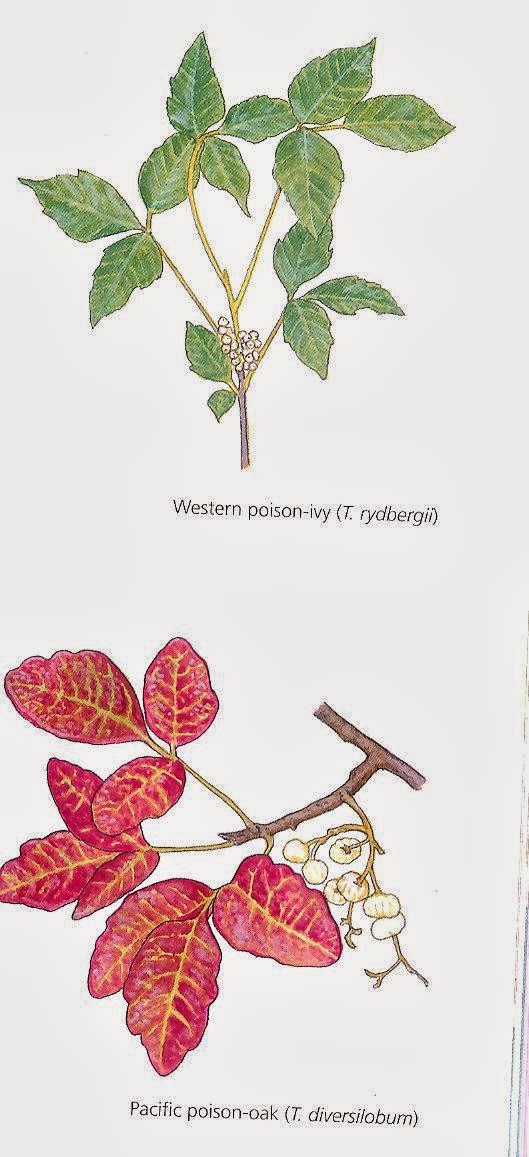
Western Poison-ivy


Western poison-Ivy is a species of drier slopes, most commonly in Interior British Columbia.
Toxicodendron radicans, commonly known as poison-ivy (older synonyms are Rhus toxicodendron and Rhus radicans), is a poisonous North American plant that is well known for its production of urushiol, a clear liquid compound found within the sap of the plant that causes an itching, irritation and sometimes painful rash in most people who touch it. The plant is not a true ivy. 
The deciduous leaves of poison ivy are trifoliate with three almond-shaped leaflets. Leaf colour ranges from light green (usually the younger leaves) to dark green (mature leaves), turning bright red in fall; though other sources say leaves are reddish when expanding, turn green through maturity, then back to red, orange, or yellow in the fall. The leaflets of mature leaves are somewhat shiny. The leaflets are one to five inches long, rarely up to twelve inches. Each leaflet has a few or no teeth along its edge, and the leaf surface is smooth. Leaflet clusters are alternate on the vine, and the plant has no thorns. Vines growing on the trunk of a tree become firmly attached through numerous aerial rootlets. The vines develop adventitious roots, or the plant can spread from rhizomes or root crowns. The milky sap of poison-ivy darkens after exposure to the air.
Poison-ivy spreads either vegetatively or sexually. Poison-ivy is dioecious; flowering occurs from May to July. The yellowish- or greenish-white flowers are typically inconspicuous and are located in clusters up to 3 inches above the leaves. The berry-like fruit, a drupe, mature by August to November with a grayish-white colour. Fruits are a favourite winter food of some birds and other animals. Seeds are spread mainly by animals and remain viable after passing through the digestive tract.
Poison-ivy can be found growing in any of the following forms:
As a trailing vine that is four to ten inches tall
As a shrub up to four feet tall
As a climbing vine that grows on trees or some other support
Distribution and Habitat
Poison ivy grows throughout much of North America, including the Canadian Maritime provinces, Quebec, Ontario, Manitoba, and all U.S. states East of the Rocky Mountains, as well as in the mountainous areas of Mexico up to around 4,900 ft. It is normally found in wooded areas, especially along edge areas where the tree line breaks and allows sunshine to filter through. It also grows in exposed rocky areas, open fields and disturbed areas.
Toxicodendron radicans may grow as a forest understory plant, although it is only somewhat shade tolerant. The plant is extremely common in suburban and exurban areas of New England, the Mid-Atlantic, and south-eastern United States.
A Similar species, poison oak, and Toxicodendron rydbergii are found in western North America. Poison ivy rarely grows at altitudes above (4,900 ft.), although the altitude limit varies in different locations The plants can grow as a shrub up to about four feet tall, as a groundcover four to ten inches high, or as a climbing vine on various supports. Older vines on substantial supports send out lateral branches that may be mistaken for tree limbs at first glance.
It grows in a wide variety of soil types, and soil pH from 6.0 (acidic) to 7.9 (moderately alkaline). It is not particularly sensitive to soil moisture, although it does not grow in desert or arid conditions. It can grow in areas subject to seasonal flooding or brackish water.
It is more common now than when Europeans first arrived in North America. A study found that poison-ivy is particularly sensitive to CO2 levels, greatly benefiting from higher CO2 in the atmosphere. Poison ivy's growth and potency has already doubled since the 1960s, and it could double again once CO2 levels reach 560 ppm. The development of real estate adjacent to wild, undeveloped land has engendered "edge effects," enabling poison ivy to form vast, lush colonies in these areas. It is listed as a noxious weed in the Canadian province of Ontario.
Outside North America, poison-ivy is also found in the temperate parts of Asia, in Japan, Taiwan, the Russian islands of Sakhalin and the Kuriles, and in parts of China.
The following four characteristics are sufficient to identify poison ivy in most situations:
 (a) clusters of three leaflets,
 (b) alternate leaf arrangement, 
(c) lack of thorns, and 
(d) each group of three leaflets grows on its own stem, which connects to the main vine.
The appearance of poison ivy can vary greatly between environments, and even within a single area. Identification by experienced people is often made difficult by leaf damage, the plant's leafless condition during winter, and unusual growth forms due to environmental or genetic factors.
Various mnemonic rhymes describe the characteristic appearance of poison ivy:
"Leaflets three; let it be" is the best known and most useful cautionary rhyme. It applies to poison oak, as well as to poison-ivy.
"Hairy vine, no friend of mine."
"Longer middle stem; stay away from them." This refers to the middle leaflet having a visibly longer stem than the two side leaflets and is a key to differentiating it from the similar-looking Rhus aromatica (fragrant sumac).
"Raggy rope, don't be a dope!" Poison ivy vines on trees have a furry "raggy" appearance. This rhyme warns tree climbers to be wary. Old, mature vines on tree trunks can be quite large and long, with the recognizable leaves obscured among the higher foliage of the tree.
"One, two, three? Don't touch me."
"Berries white, run in fright" and "Berries white, danger in sight."
"Red leaflets in the spring, it's a dangerous thing." This refers to the red appearance that new leaflets sometimes have in the spring. (Note that later, in the summer, the leaflets are green, making them more difficult to distinguish from other plants, while in autumn they can be reddish-orange.)
"Side leaflets like mittens, will itch like the dickens." This refers to the appearance of some, but not all, poison ivy leaves, where each of the two side leaflets has a small notch that makes the leaflet look like a mitten with a "thumb." (Note that this rhyme should not be misinterpreted to mean that only the side leaflets will cause itching, since actually all parts of the plant can cause itching.)
"If it's got hair, it won't be fair." This refers to the hair that can be on the stem and leaves of poison ivy.
Blisters from Contact with Poison ivy
The oozing fluids released by scratching blisters do not spread the poison. The fluid in the blisters is produced by the body and it is not urushiol itself.The appearance of a spreading rash indicates that some areas received more of the poison and reacted sooner than other areas or that contamination is still occurring from contact with objects to which the original poison was spread. 
The blisters and oozing result from blood vessels that develop gaps and leak fluid through the skin; if the skin is cooled, the vessels constrict and leak less. If poison ivy is burned and the smoke then inhaled, this rash will appear on the lining of the lungs, causing extreme pain and possibly fatal respiratory difficulty. 
If poison ivy is eaten, the mucus lining of the mouth and digestive tract can be damaged. A poison ivy rash usually develops within a week of exposure and can last anywhere from one to four weeks, depending on severity and treatment. In rare cases, poison ivy reactions may require hospitalization.
Urushiol oil can remain active for several years, so handling dead leaves or vines can cause a reaction. In addition, oil transferred from the plant to other objects (such as pet fur) can cause the rash if it comes into contact with the skin. Clothing, tools, and other objects that have been exposed to the oil should be washed to prevent further transmission.
People who are sensitive to poison ivy can also experience a similar rash from mangoes. Mangoes are in the same family (Anacardiaceae) as poison ivy; the sap of the mango tree and skin of mangoes has a chemical compound similar to urushiol. A related allergenic compound is present in the raw shells of cashews. Similar reactions have been reported occasionally from contact with the related Fragrant Sumac (Rhus aromatica) and Japanese lacquer tree. These other plants are also in the Anacardiaceae family.
Treatment of Poison ivy Rash
Immediate washing with soap and water or rubbing alcohol may help prevent a reaction. During a reaction, Calamine lotion or diphenhydramine may help mitigate symptoms. Corticosteroids, either applied to the skin or taken by mouth, may be appropriate in extreme cases.
Urushiol binds to the skin on contact, where it causes severe itching that develops into reddish coloured inflammation or non-coloured bumps, and then blistering. These lesions may be treated with Calamine lotion, Burow's solution compresses or baths to relieve discomfort though recent studies have shown some traditional medicines to be ineffective] Over-the-counter products to ease itching—or simply oatmeal baths and baking soda—are now recommended by dermatologists for the treatment of poison ivy.
 A plant based remedy cited to counter urushiol induced contact dermatitis is jewelweed. "The results of a clinical study, in which a 1:4 jewelweed preparation was compared for its effectiveness with other standard poison ivy dermatitis treatments was published in 1958 Of 115 patients treated with jewelweed, 108 responded ‘most dramatically to the topical application of this medication and were entirely relieved of their symptoms within 2 or 3 days after the institution of treatment.' It was concluded that jewelweed is an excellent substitute for ACTH and the corticosteroids in the treatment of poison ivy dermatitis. Other sources have since concluded that jewelweed is ineffective or of questionable effectiveness.
Box-elder, a harmless ornamental tree, found on many lawns and boulivards (Acer negundo), saplings have leaves that can look very similar to those of poison ivy, although the symmetry of the plant itself is very different. While box-elders often have five or seven leaflets, three leaflets are also common, especially on smaller saplings. The two can be differentiated by observing the placement of the leaves where the leaf stalk meets the main branch (where the three leaflets are attached). Poison ivy has alternate leaves, which means the three-leaflet leaves alternate along the main branch. The maple (which the box-elder is a type of) has opposite leaves; another leaf stalk directly on the opposite side is characteristic of box-elder.
Virginia creeper (Parthenocissus quinquefolia) vines can look like poison ivy. The younger leaves can consist of three leaflets but have a few more serrations along the leaf edge, and the leaf surface is somewhat wrinkled. However, most Virginia creeper leaves have five leaflets. Virginia creeper and poison ivy very often grow together, even on the same tree. Be aware that even those who do not get an allergic reaction to poison ivy may be allergic to the oxalate crystals in Virginia creeper sap.
Western Poison-oak (Toxicodendron diversilobum) leaflets also come in threes on the end of a stem, but each leaflet is shaped somewhat like an oak leaf. Western Poison-oak grows only in the western United States and Canada, although many people will refer to poison ivy as poison-oak. This is because poison ivy will grow in either the ivy-like form or the brushy oak-like form depending on the moisture and brightness of its environment. The ivy form likes shady areas with only a little sun, tends to climb the trunks of trees, and can spread rapidly along the ground.
Poison Sumac (Toxicodendron vernix) has compound leaves with 7–15 leaflets. Poison sumac never has only three leaflets.
Kudzu (Pueraria lobata) is a non-toxic edible vine that scrambles extensively over lower vegetation or grows high into trees. Kudzu is an invasive species in the southern United States. Like poison ivy, it has three leaflets, but the leaflets are bigger than those of poison ivy and are pubescent underneath with hairy margins.
The thick vines of Riverbank Grape (Vitis riparia), with no rootlets visible, differ from the vines of poison ivy, which have so many rootlets that the stem going up a tree looks furry. Riverbank grape vines are purplish in colour, tend to hang away from their support trees, and have shreddy bark; poison ivy vines are brown, attached to their support trees, and do not have shreddy bark.
Fragrant Sumac (Rhus aromatica) has a very similar appearance to poison ivy. While both species have three leaflets, the centre leaflet of poison ivy is on a long stalk, while the centre leaflet of fragrant sumac does not have an obvious stalk. When crushed, fragrant sumac leaves have a fragrance similar to citrus while poison ivy has little or no distinct fragrance. Fragrant sumac produces flowers before the leaves in the spring, while poison ivy produces flowers after the leaves emerge. Flowers and fruits of fragrant sumac are at the end of the stem, but occur along the middle of the stem of poison ivy. Fragrant sumac fruit ripens to a deep reddish colour and is covered with tiny hairs while poison ivy fruit is smooth and ripens to a whitish colour.

Hoptree (Ptelea trifoliata) has leaves that are remarkably similar. It is, however, a much larger plant so confusion is unlikely for any but the smallest specimens. The flowers and seeds are also easily distinguished from those of poison ivy. ©Al (Alex-Alexander) D Girvan. All rights reserved.

Pacific Poison Oak


Poison oak is a deciduous shrub, which like POISON IVY IS in the SUMAC FAMILY, native to North America.

Its leaves contain a compound that causes a rash on human skin.

Poison Oak can Specifically Refer to:
Toxicodendron pubescens, which grows in Eastern North America
Toxicodendron diversilobum, which grows in Western Coast of North America

Poison oak (Toxicodendron diversilobum) and its EASTERN COUNTERPART poison ivy (T. radicans) are two of the North American plants most painful to humans.

 Note: These species were formerly placed in the genus Rhus. Poison oak and a related, look-alike shrub, Rhus trilobata belong to the SUMAC family (Anacardiaceae).

Poison oak is widespread throughout the mountains and valleys of the western USA. It thrives in shady canyons and riparian habitats. It commonly grows as a climbing vine with aerial (adventitious) roots that adhere to the trunks of oaks and sycamores.

Rocky Mountain poison oak (Toxicodendron rydbergii) occurs in canyons throughout western Canada. Because the two species of western poison oak look like a vine as they develop, some authors list poison oak as a subspecies of eastern poison ivy.

Poison oak often grows like a climbing vine.
The cautionary rhyme "leaves of three, let it be" applies to poison oak, as well as to poison ivy (Toxicodendron radicans). Toxicodendron diversilobum, commonly named Pacific poison oak or western poison oak (syn. Rhus diversiloba), is in the Anacardiaceae family (the sumac family).
The woody vine or shrub is widely distributed in western North America, inhabiting conifer and mixed broadleaf forests, woodlands, grasslands, and chaparral biomes. It is known for causing itching and allergic rashes in many humans, after contact by touch or smoke inhalation.
The Pacific poison-oak Toxicodendron species is found in California, Nevada, Oregon, Washington, and British Columbia. The closely related Eastern poison oak (Toxicodendron pubescens) is native to the Southeastern United States. Pacific poison-oak and Western poison-ivy (Toxicodendron rydbergii) hybridize in the Columbia River Gorge area.
Toxicodendron diversilobum is common in various habitats. It thrives in shady and dappled light through full and direct sunlight conditions, at elevations below 5,000 feet. The vine form can climb up large shrub and tree trunks into their canopies. Sometimes it kills the support plant by smothering or breaking it.
The plant often occurs in chaparral and woodlands, coastal sage scrub, grasslands, and oak woodlands; and Douglas-fir (Pseudotsuga menzesii), Hemlock—Sitka spruce, Coast redwood (Sequoia sempervirens), Yellow Pine (Pinus ponderosa), and mixed evergreen forests.

Description
Toxicodendron diversilobum, Pacific or western poison oak, is extremely variable in growth habit and leaf appearance. It grows as a dense one and a half to thirteen foot, tall shrub in open sunlight; also as a tree like vine ten to thirty feet high and may be more than more than one hundred feet long with a three to eight inch trunk. It reproduces by spreading rhizomes and by seeds.

Pacific Poison-oak foliage.
The plant is deciduous, so that after cold weather sets in, the stems are leafless and bear only the occasional cluster of berries. Without leaves, poison oak stems may sometimes be identified by occasional black marks where its milky sap may have oozed and dried.

The leaves are divided into three (rarely five,seven or nine) leaflets, one and one a half to four inches long, with scalloped, toothed, or lobed edges. They generally resemble the lobed leaves of a true oak, though the Pacific poison oak leaves will tend to be glossier. Leaves are typically bronze when first unfolding in February to March, bright green in the Spring, yellow-green to reddish in the Summer, and bright red or pink from late July to October.
White flowers form in the spring, from March to June. If they are fertilized, they develop into greenish-white or tan berries.
Botanist John Howell observed the toxicity of Toxicodendron diversilobum obscures its merits:
"In spring, the ivory flowers bloom on the sunny hill or in sheltered glade, in summer its fine green leaves contrast refreshingly with dried and tawny grassland, in autumn its colours flame more brilliantly than in any other native, but one great fault, its poisonous juice, nullifies its every other virtue and renders this beautiful shrub the most disparaged of all within our region”

Pacific poison oak leaves and twigs have a surface oil, urushiol, which causes an allergic reaction. It causes contact dermatitis- an immune-mediated skin inflammation- IN 4/5 OF HUMANS However, most, if not all, will become sensitized over time with repeated or more concentrated exposure to urushiol.

Pacific Poison-Oak grows on drier rocky slopes at lower elevations on south-eastern Vancouver Island and nearby Gulf Island.

Reactions:
Urushiol-induced contact dermatitis from poison oak.
Pacific poison oak skin contact first causes itching; then evolves into dermatitis with inflammation, colourless bumps, severe itching, and blistering. In the dormant deciduous seasons the plant can be difficult to recognize, however leafless branches and twigs contact also causes allergic reactions.
Contrary to what has been written by other authors and posted on other web-sites Urushiol volatilizes when burned; SO IT IS, INDEED, CARRIED THROUGH THE AIR to unsuspecting victims.
 And, human exposure to Toxicodendron diversilobum smoke is extremely hazardous, from wildfires, controlled burns, or disposal fires. The smoke can poison people who thought they were immune. The resin can persist on pets and clothing for months and is also ejected in fine droplets into the air when the plants are pulled.
Branches used to toast food over campfires can cause reactions internally and externally, although, or so it is claimed, the Karok peoples traditionally used them as a cooking tool.
Ecology: Black-tailed deer, Mule deer, ground squirrels, Western grey squirrels, and other indigenous fauna feed on the leaves of the plant. It is rich in phosphorus, calcium, and sulphur. Bird species use the berries for food, and utilize the plant structure for shelter. Native animals, horses, livestock, canine pets, DO NOT demonstrate reactions to urushiol.
Due to human allergic reactions, Pacific poison oak plants are usually eradicated in gardens and public landscaped areas. It can be a weed in agricultural fields, orchards, and vineyards. It is usually removed by pruning, herbicides, digging out, or a combination of these.

Uses:
Native North Americans used the plant's stems and shoots to make baskets, the sap to cure ringworm, and as a poultice of fresh leaves applied to rattlesnake bites. The juice or soot was used as a black dye for sedge basket elements, tattoos, and skin darkening.
An infusion of dried roots, or buds, eaten in the spring, were taken by some native peoples for an immunity from the plant poisons.

Chumash peoples used Pacific poison-oak sap to remove warts, corns, and calluses; to cauterize sores; and to stop bleeding. They also drank a decoction made from Pacific poison-oak roots to treat dysentery.
© Al (Alex-Alexander) D Girvan> All rights reserved.